Yesterday, we told you about the latest on S.B. 4. Today, the U.S. Supreme Court has extended the stay until March 18, 2024. This pushes the earliest effective date of the new illegal immigration law to next Monday.
February 29, 2024: The U.S. District Court for the Western District of Texas granted a preliminary injunction enjoining the enforcement of S.B. 4 because it violates the Supremacy Clause of the U.S. Constitution. Article VI, Clause 2 of the U.S. Constitution, the Supremacy Clause, establishes that the U.S. Constitution and any federal laws made pursuant to it constitute the supreme law of the land and thus take precedence over any conflicting state laws.
March 2, 2024: The Fifth Circuit Court of Appeals ordered a temporary administrative stay overturning the District Court’s injunction. The Fifth Circuit, however, placed a seven-day stay on its administrative stay to give the federal government an opportunity to appeal this decision to the U.S. Supreme Court. The Fifth Circuit also stated that it will hear oral arguments on the constitutionality of S.B. 4 as soon as possible.
March 4, 2024: The U.S. Supreme Court ordered an administrative stay on the Fifth Circuit’s order until 4:00 p.m. (CDT) on March 13, 2024. The Supreme Court further ordered Texas to submit a response by March 11.
March 12, 2024:The U.S. Supreme Court extended the administrative stay on the Fifth Circuit’s order until 4:00 p.m. (CDT) on March 18, 2024.
Stay Tuned (and Save the Date)
TMCEC will continue to monitor this fluid situation and keep constituents apprised of updates. Mark your calendar! S.B. 4 and recent changes regarding the confidentiality of court work product information will be the focus of a special TMCEC Morning Coffee on Thursday, March 21st at 10:00 a.m. Additional information will be shared in the weeks and months ahead.
S.B. 4 Implementation Temporarily Paused Pending U.S. Supreme Court Review
For months, TMCEC has been monitoring S.B. 4, the “Texas Illegal Immigration Law.” The bill, scheduled to go into effect on March 5th, is embroiled in federal litigation. While a federal trial court issued a 114-page decision stopping the bill from taking effect, two days later a federal court of appeals “reversed course” saying that it would allow the bill to go into effect while the case against it proceeded in the courts. Now all eyes are on the U.S. Supreme Court, which issued a temporary administrative stay that expires this week.
Supreme Court of the United States
What Municipal Courts Need to Know about S.B. 4
On December 18, 2023, during the fourth special session, the Texas Legislature passed S.B. 4 with a March 5, 2024 effective date. Among other things, S.B. 4 adds Chapter 51 to the Penal Code, which creates state offenses related to illegal entry into Texas ranging in punishment from Class B misdemeanor to second degree felony.
Importantly, for municipal judges who perform magistrate duties, S.B. 4 creates Chapter 5B of the Code of Criminal Procedure. Article 5B.002(a) gives magistrates the discretion, following a probable cause determination, to order the discharge of a person arrested for the newly created offenses in Chapter 51 of the Penal Code (Sections 51.02 and 51.03) and issue a written order requiring the person to return to the foreign nation from which he or she entered or attempted to enter the United States. The arrestee:
Must agree to the order;
Must not have been previously convicted of an offense under Chapter 51 or discharged under Article 5B.002; and
Must not be charged with another Class A misdemeanor or higher offense.
If a magistrate chooses to issue an order under Article 5B.002, the order must include (1) the manner of transportation of the person to a port of entry and (2) the law enforcement officer or state agency responsible for monitoring compliance with the order. Magistrate orders under Article 5B.002(a) must be filed with the county clerk of the county where the person was arrested.
Furthermore, prior to the issuance of an order under Article 5B.002, the arresting law enforcement agency must collect all available identifying information on the arrestee, including taking fingerprints, and cross-reference it against all relevant criminal databases.
Federal Court Activity Timeline
February 29, 2024: The U.S. District Court for the Western District of Texas granted a preliminary injunction enjoining the enforcement of S.B. 4 because it violates the Supremacy Clause of the U.S. Constitution. Article VI, Clause 2 of the U.S. Constitution, the Supremacy Clause, establishes that the U.S. Constitution and any federal laws made pursuant to it constitute the supreme law of the land and thus take precedence over any conflicting state laws.
March 2, 2024: The Fifth Circuit Court of Appeals ordered a temporary administrative stay overturning the District Court’s injunction. The Fifth Circuit, however, placed a seven-day stay on its administrative stay to give the federal government an opportunity to appeal this decision to the U.S. Supreme Court. The Fifth Circuit also stated that it will hear oral arguments on the constitutionality of S.B. 4 as soon as possible.
March 4, 2024: The U.S. Supreme Court ordered an administrative stay on the Fifth Circuit’s order until 4:00 p.m. (CDT) on March 13, 2024. The Supreme Court further ordered Texas to submit a response by March 11.
Stay Tuned (and Save the Date)
If the U.S. Supreme Court does not intervene, S.B. 4 could take effect this Wednesday, March 13th. TMCEC will continue to monitor this fluid situation and keep constituents apprised of updates. Mark your calendar, S.B. 4 and recent changes regarding the confidentiality of court work product information will be the focus of a special TMCEC Morning Coffee on Thursday, March 21st at 10:00 a.m. Additional information will be shared in the weeks and months ahead.
Under Rule 7.1, every court must, no later than May 1, 2024, adopt a policy governing court confidentiality. The policy must: (1) define who it applies to, (2) define confidential information, (3) impose a duty of confidentiality on all court staff that continues after employment at the court ends, (4) address when, if ever, the disclosure of confidential information is authorized, (5) provide the language of relevant laws, (6) address negligent or accidental disclosure of confidential information, (7) warn of potential penalties for improper disclosure, and (8) require all court staff to acknowledge receipt of the policy in writing. The policy must be provided to all new court staff members and training on it must given prior to the new staff member beginning any substantive work for the court. Furthermore, all existing court staff members must be provided with the policy biannually.
The Texas Supreme Court has provided a sample Confidentiality Policy and Agreement. Because this is a generic sample for all courts, it does not mention the municipal-court-specific confidentiality provisions contained in Articles 45.0217/45A.462, 45.0218/45A.055, and 45.313 of the Code of Criminal Procedure. TMCEC has created an adapted municipal-court-specific sample, which includes, among other things, these statutes. (See the download link below.) If a municipal court opts to base its policy on either of these samples, TMCEC highly encourages the court to closely examine and adapt it as necessary to ensure compatibility with the specific court’s operations, as well as state law.
If you would like to hear more about this new development, please join TMCEC on Thursday, March 21, 2024 at 10:00am for a Morning Coffee webinar regarding Rule 7.1. We hope to see you there!
Just as municipal courts occupy a unique niche in the Texas judicial system, so do municipal prosecutors. From the smallest town to the largest city, prosecutorsinmunicipal courts play a vital role in the administration of justice. It is estimated that more than 700 attorneys licensed in Texas prosecute in municipal courts.
Compared to other prosecutors, municipal prosecutors handle the most cases, conduct the most trials, and have more contact with members of the public. While all prosecutors in Texas have a duty, not to convict, but to see that justice is done, the challenge of ensuring justice in a municipal court is further complicated by laws that are similar but different from those in county and district courts.
These differences, combined with regular changes in the law by the Texas Legislature, make specialized legal training essential. Since 1992, through a grant from the Texas Court of Criminal Appeals, TMCEC has offered specialized continuing legal education to prosecuting attorneys who serve in municipal courts across the state.
Because obtaining specialized knowledge is a hallmark of professionalism and requires commitment and focus, TMCEC believes it also deserves special recognition. Accordingly, beginning in 2024, TMCEC is excited to announce the introduction of the Prosecutor Professionalism Program (PPP).
Components of Professionalism
With this program, we aim to encourage and reward prosecutors who obtain annual specialized municipal court-focused training through TMCEC.
Basic Requirements:
Active Prosecutor: Applicants must hold a current post as a prosecutor for a Texas municipality (part time or full time).
Hours: Applicants must complete 20 hours of education (this will be calculated by attendance hours, not CLE hours, and must be timely reported through a Record of Attendance) through TMCEC within one academic year in the following manner:
16 hours in attendance at the annual three -day Prosecutors Conference
4 hours from any combination of the following:
TMCEC Webinars
TMCEC In-Person or Virtual Training
Application: Once the hours are earned, interested prosecutors will apply to the Center, attesting to both the number of hours earned and the way they were earned.
Recognition:
Those who complete the educational requirements and application process will be recognized in the following ways:
Recognition by name and city in The Recorder, on the TMCEC website, and via TMCEC social media.
Downloadable certificates, awarded on a year-to-year basis, designating the holder as a member of the TMCEC Prosecutors Professionalism Program class for a given academic year.
Name badge ribbons at live events.
We hope you’ll consider becoming a member of the inaugural TMCEC Prosecutor Professionalism Class of 2024.
The first step is attending the full three-day program at one of our two Prosecutors Seminars:
Please note that the Prosecutors Seminars offer CLE credit as well. For more information about the TMCEC Prosecutors Seminar (including registration), Prosecutors Listserv, who can prosecute in municipal court, and the unique role of city attorneys, click here.
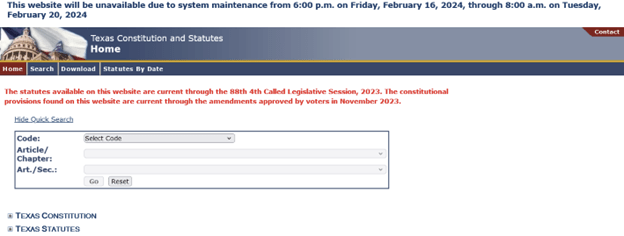
The state maintains a wonderful website where every Texas statute is available at the click of a button. Users should be aware that the website will go down for maintenance at 6:00 pm Friday, February 16, 2024 and will be down all weekend until 8:00 am on Tuesday, February 20, 2024.
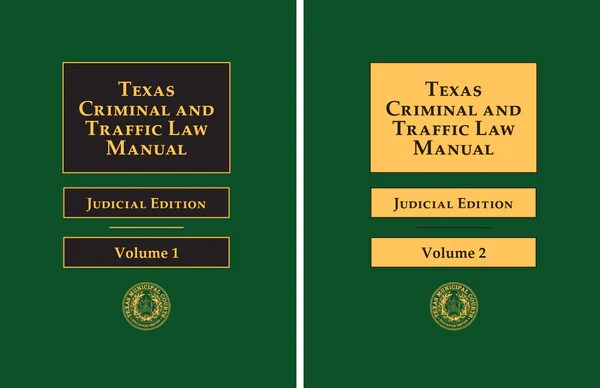
What will you do until then? Order your copy of the new, updated TMCEC Texas Criminal and Traffic Law Manual today! This bundle contains Volume 1 and Volume 2 of the Texas Criminal and Traffic Law Manual along with a searchable eBook version of both volumes. The two volumes are curated by TMCEC to include the codes most relevant to municipal courts. It is current through the 88th (2023) Regular Legislative Session. This 2023-2025 edition features an expanded scope when compared to prior editions and includes provisions from the Texas Code of Criminal Procedure, Penal Code, Transportation Code, Education Code, Family Code, Government Code, Health & Safety Code, Local Government Code, and much more. Additionally, this code book works when the internet is down or the power is out!
Effective for offenses committed on or after September 1, 2023, the fine range for violating Section 545.157 of the Transportation Code, which prohibits improperly passing stationary vehicles such as police cars and tow trucks, increased from $1-$200 to $500-$1,250. See H.B. 898 (2023). This change has led some municipal courts to question whether defendants charged with this offense are still eligible to have their case dismissed via a Driving Safety Course (DSC) under Section 45.0511 of the Code of Criminal Procedure. The answer is yes, assuming the defendant meets Section 45.0511’s other requirements. H.B. 898 made no changes to Section 45.0511(p), which is where offenses ineligible for DSC, such as improperly passing a school bus, are listed. Despite the increased fine range, improperly passing an emergency vehicle under Section 545.157 is still one of the “Rules of the Road” (Subtitle C, Title 7 of the Transportation Code) within municipal court jurisdiction that is eligible for dismissal under the DSC statute.
On August 25, 2023, the Supreme Court of Texas issued a Rules Advisory that it had preliminarily approved a change to Rule 7 of the Rules of Judicial Administration. This rule change will affect municipal courts, if enacted in the current form. The advisory also invited public comment, and the public comment period ends February 1, 2024. The expected effective date of the rule is March 1, 2024. Once effective, the rule will require courts to adopt confidentiality policies by May 1, 2024
In its current form, the rule change creates a new Rule 7.1. The current text of Rule 7 regarding District and County courts becomes Rule 7.2.
The new Rule 7.1 would require all courts, including municipal courts, to adopt a policy governing court confidentiality. The policy would be required to conform to eight conditions defining the scope of the policy, its parameters, and the potential penalties for violation of the policy. All court staff would be required to acknowledge receipt of the policy in writing. All existing staff must receive the policy and training on it by May 1, and receive the policy at least biannually thereafter. Any new staff must receive the policy and training before beginning any substantive work for the court.
The Rules Advisory linked above includes a four-page sample policy which the Supreme Court has drafted to meet all the requirements of the Rule. Because this policy is drafted for all courts, it does not mention the municipal-court-specific confidentiality provisions contained in the Code of Criminal Procedure Articles 45.0217/45A.462, 45.0218/45A.055, and 45.313. A municipal court may choose to add language about these articles to, for example, the definition of confidential information in the court’s policy.
Although the rule has preliminary approval, courts are still invited to comment until February 1. After March 1, the Supreme Court will announce the rule in its final form on its Rules Advisory webpage.
Daylight savings time has come around again. Communities across Texas have kicked off programs that coincide with daylight savings to encourage homeowners to check the batteries in their smoke alarms. For municipal courts, a similar thing happens every summer of an odd-numbered year: time to reexamine any city charters, ordinances, and procedures related to the municipal court to ensure compliance with a new batch of laws.
For example, effective September 1, 2023, the Legislature amended Section 61.001(a) of the Texas Government Code to raise the juror reimbursement rate from $6 per day to $20 per day. See H.B. 3474 (2023). Subsection (c), however, was unchanged, which provides that jurors in municipal court are not entitled to reimbursement. Municipalities may nonetheless elect to provide jury reimbursement and determine the amount.
Practically speaking, there are three approaches a municipality may take when it comes to juror reimbursement: pay nothing, pay a fixed amount, or pay an amount equal to the rate in the Government Code. If a city ordinance or resolution is based on either of the first two methods, no changes are needed. However, if it is based on the third method, the city will either need to pay the $20 per day or modify the ordinance.
Remember, the best time to familiarize yourself with the city’s court-related ordinances was when they passed. The second-best time is now.
On November 7, 2023, Texans voted on 14 proposed amendments to the Texas Constitution. The only amendment voters rejected was Proposition 13, which would have, among other things, increased the mandatory retirement age for certain state judges from 75 to 79. This age requirement, which is provided in Section 1-a(1), Article V of the Texas Constitution, was adopted in 1965. Proposition 13 made the ballot through House Joint Resolution 107 (2023), which passed both the House and Senate.
Publicity surrounding Proposition 13 has led some to question whether Section 1-a(1)’s mandatory retirement provision applies to municipal judges. Section 1-a(1) provides that it applies to “Justices and Judges of the Appellate Courts and District and Criminal District Courts.” Because municipal court judges do not fit this criteria, Section 1-a(1)’s age requirements do not apply to municipal judges. In other words, there is no statewide mandatory retirement age for municipal judges in Texas. If Proposition 13 had passed, it would not have impacted municipal judges.
Next week is Municipal Courts Week! The 88th Texas Legislature designated the first week of November as Municipal Courts Week each year from 2023 through 2032 via House Concurrent Resolution 75. “First Week” means the first full Monday through Friday of November. This year, that’s November 6-10.
TMCEC General Counsel and Director of Education Mark Goodner sat down with Ned Minevitz and Liz De La Garza to discuss what cities are doing and can do for this event.
Mark Goodner (MG): Good afternoon, Ned and Liz. It’s hard to believe that it’s already been well over a month since we chatted about Municipal Courts Week on our webinar (Municipal Courts Week, H.C.R. 75, and Community Engagement) https://tmcec.brightspace.com/d2l/home/6914). Now, Municipal Courts Week is next week! What have you seen and heard about what municipal courts are doing next week to mark the occasion?
Ned Minevitz (NM): Hello, Mark. That was a fun webinar! This year a lot of mayors have already passed a resolution officially designating November 6-10 as Municipal Courts Week. I have also seen many courts promoting Municipal Courts Week through social media to inform the public about any open events. Municipal Courts Week is a perfect time for judges and court staff to engage with members of their communities in a positive way.
Liz De La Garza (LDLG): Hey Mark! We always have an enjoyable time talking about what courts can do to reach out to their communities, and Municipal Courts Week is a great time to do this! Courts have responded to this opportunity by contacting us and letting us help them find ways to celebrate their courts! Courts are opening their doors to their communities with open houses and honoring the hard work of their staffs with breakfasts and little tokens of appreciation.
MG: I’m glad you mentioned passing a local resolution and/or proclamation. I think that’s a great and “official” option to celebrate courts. We even have a sample template (see link below) to assist cities that would like to do that. Additionally, we have a press release template that cities can use to report to local media about Municipal Courts Week events. Are there any other resources available that could help courts with last-minute plans?
LDLG: Courts using their local papers and social media to announce Municipal Court Week to their communities is a great idea! Local papers are always looking for ways to highlight their cities. The demanding work that city staff and municipal courts do daily is often unheralded. Putting an article in the community paper is an awesome way to shed light on this important work! Social media is another even quicker way to do this same thing, and its effect is immediate! Most citizens under the age of 40 usually do not read the local paper in its hard form, but they will read that exact same news presented on an online version!
NM: If a court has never celebrated Municipal Courts Week but would like to, they can give me a call at 512-320-8274 and I am happy to assist in coming up with a plan that could be implemented quickly and with relative ease. While it is too late to order physical traffic safety materials from TMCEC, check out TMCEC’s Municipal Courts Week and Traffic Safety Resources webpages for inspiration and ideas on how to make the most of Municipal Courts Week. The proclamation and press release templates you referenced are both available on the Municipal Courts Week webpage.
MG: Thank you. Municipal Courts Week is a great opportunity to show appreciation to court staff as well as to host a public event. Are there any events from years past that stick out in your mind as being especially effective or memorable?
NM: Over the years a few courts have hosted a traffic safety coloring contest for kids. I have always found this super effective because the children not only have a blast, but they also think about safe practices such as wearing a seatbelt and looking both ways before crossing the street. It also does not hit the city’s pocketbook very hard: all that is needed is some paper and crayons! Another place to see some of the exemplary events courts have recently hosted is TMCEC’s 2023 Best Practices Brochure.
LDLG: As a retired teacher, I know how important even little accolades are for staff, especially workers who do important, yet not very visible, work that keeps their cities safe and humming along. We saw one city where the administrative staff put a little something (a small candy bar or a small funny gift) with an encouraging note on each person’s desk every morning of Municipal Courts Week. At the end of the week, they hosted a breakfast where staff were celebrated as individuals and as a team. Seeing the pictures of the breakfast was great – everyone looked so happy and collegial. A little encouragement goes a long way in keeping staff at their best!
MG: I should also mention that this could be a chance to connect with and inform city hall, as well. Our C3 public information and education campaign is designed to fill the information gap between city halls and municipal courts in Texas. Municipal Court personnel should check out issues of The Brief available online as well as videos such as The Role of Municipal Court in City Government. Thanks for your time, Ned and Liz!
Please share in a comment below what you plan to do for Municipal Courts Week!




 Full Court Press