by Ned Minevitz and Madison Mondragon
Must Extra Information in a Complaint be Proven at Trial?
Article 45A.101 of the Code of Criminal Procedure provides the necessary information to include when drafting a sufficient complaint to initiate criminal proceedings in municipal court. This blog will focus on Article 45A.101(a)(4), which requires either a statement that the accused has committed an offense or that there is good reason to believe, and the affiant does believe, that the accused has committed an offense.
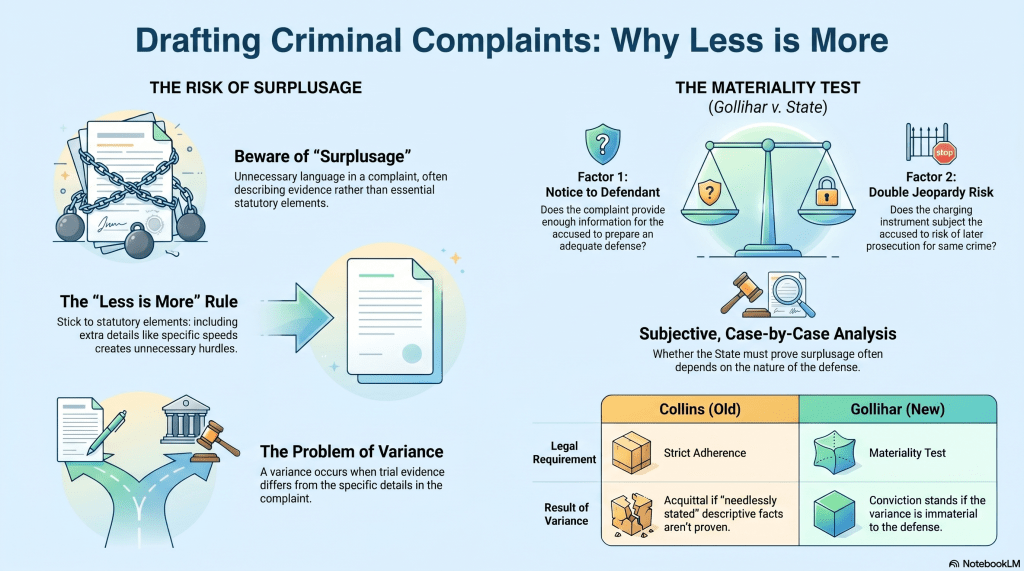
In a Complaint, Less is More
To satisfy Article 45A.101(a)(4), simply stating the statutory elements of the offense alleged is sufficient. There is no need to include specific details related to how the elements were met. For example, if the State charged a person with speeding under Section 545.351 of the Transportation Code, the complaint should convey that the person committed each element by tracking the exact language of Section 545.351, such as “[drove] a vehicle at a speed greater than [was] reasonable and prudent under the conditions….” The precise speed that the vehicle was allegedly travelling might be relevant at trial, but it is not an element and, therefore, should not be included in the complaint.
There may be a temptation to emphasize the severity of an alleged offense by including additional details. However, unnecessary details will create additional hurdles that the State would likely need to confront at trial. For example, would the State now need to prove beyond a reasonable doubt that the defendant was traveling at the exact speed alleged in the complaint?
Collins, Surplusage, and Variances
Including the alleged miles per hour traveled is an example of “surplusage.” Surplusage is unnecessary or extra language. Surplusage is often a description of evidence that the State plans to use at trial. When there is a difference between what is in the charging instrument and what is ultimately proven at trial, it is called a variance. In 1973, the Court of Criminal Appeals established a rule about surplusage: if information included in the complaint was “descriptive of that which is legally essential to charge a crime it must [have been] proven as alleged, even though needlessly stated.” Collins v. State, 500 S.W.2d 168 (Tex. Crim. App. 1973).
Gollihar and Materiality
In 2001, the Court overturned the rule laid out in Collins. In Gollihar v. State, 46 S.W.3d 243 (Tex. Crim. App. 2001), a man was convicted of stealing a go-cart. In the charging instrument, the State alleged that the stolen go-cart’s model number was 136202. At trial, the evidence showed that the model number was actually 136203. Here, the complaint contained both surplusage and variance. The court of appeals ordered an acquittal because, under Collins, even though the state proved all the elements of the offense, the state did not prove that the defendant stole a go-cart with model number 136202.
The Court of Criminal Appeals reversed and set out a new test: materiality. The Court advanced a two-factor test to determine if a variance between what is in the charging instrument and what is proven at trial is material: (1) whether the charging instrument informs the defendant of the charge against him sufficiently to allow him to prepare an adequate defense at trial and (2) whether the charging instrument would subject the accused to the risk of being later prosecuted for the same crime. In Gollihar, the Court concluded that the incorrect model number did not impair the defendant’s ability to prepare his defense, which did not depend on the model number alleged. Furthermore, the variance created no risk of double jeopardy. Because the variance was immaterial, the original conviction was reinstated.
Conclusion
When looking at our earlier hypothetical, must the State prove the exact speed that the defendant was driving as listed in the complaint? Because of the Gollihar test’s subjective, case-by-case nature, it depends. The answer would likely hinge on the specific nature of the accused’s defense. If the defendant had prepared his defense by seeking to rebut the exact speed alleged in the complaint, the State would likely need to prove the exact speed alleged under Gollihar. But if the defendant argues that he was not even driving a car that day, the State might not need to prove the exact speed alleged. Fortunately, well-drafted complaints that do not include unnecessary information are not subject to the Gollihar test.
Check back tomorrow for some Tips for Effective Charging!

