Today is the Day! All Remaining AY23 Judicial Education Hours are Due 8/31/2023!

Today marks the last day of the 2022-2023 Academic Year for judges to complete their required judicial education.

On March 30, 2020, the Court of Criminal Appeals issued an emergency order suspending all sections of the Rules of Judicial Education that require live, continuous hours of judicial education that would prevent a judge from completing his or her hours during the disaster. Governor Abbott did not renew the disaster declaration on June 15, 2023. Therefore, the emergency order suspending portions of the Rules of Judicial Education expired July 15, 2023. However, to promote certainty for judges planning their education hours, the Municipal Courts Education Committee passed a resolution providing that the status of the Rules of Education in effect on September 1st shall remain in effect through August 31, 2023. 

Typically, each judge would need to satisfy at least eight of the required 16 hours (or all 16 for a judge completing a first or second year of education) through live, continuous training. Now, however, all 16 hours can be completed by electronic means through the end of this academic year. That’s today.

Canon 3B(2) of the Texas Code of Judicial Conduct was recently updated to specify that judges must meet all judicial education requirements set forth in governing statues or rules. Additionally, the Rules of Judicial Education require the Education Committee to submit the names of nonconforming judges to the Commission of Judicial Conduct by November 1.

TMCEC currently offers dozens of webinars on demand. Viewing webinars is a permissible method to satisfy your hours while the emergency order is in effect.   

  Finally, if illness or emergency is preventing you from completing the educational requirements this year, keep in mind that you may request a waiver (but the waiver will not be considered until late September 2023).  If you have completed other relevant CLE or judicial education, you may submit an Intent to Opt Out form or request flex-time credit if you have completed at least two years of training and did not opt out of TMCEC training last year. For more information, see the Opt Outs & Waivers and Judicial Flex Time pages on the TMCEC website.    

Checking the Number of Hours on Your Transcript

To check the current number of hours on your transcript, log into your registration account and click on the Transcript/Events tab, then click on the Transcript button. This is the same transcript that TMCEC staff would see. Count the hours earned between 9/1/2022 and 8/31/2023.

Refreshing and Updating Your Transcript

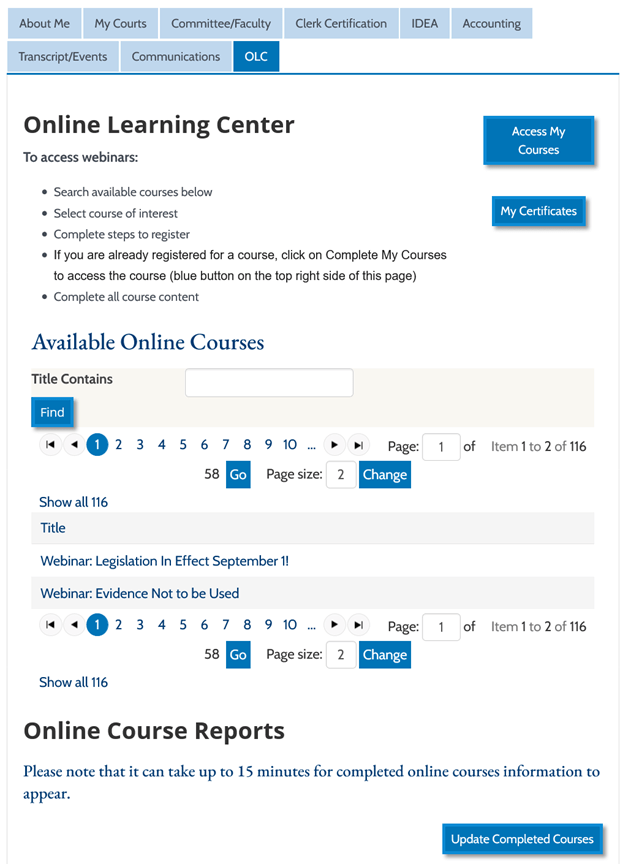
If you are certain you completed one or more webinar that is not reflected on your transcript and are certain you completed the evaluation and record of attendance, then clicking on the Update Completed Courses button while on the OLC tab will update your transcript. See the button in the bottom right corner of the screen grab below:

 TMCEC is committed to assisting you with your educational requirements this year, and we are happy to answer your questions regarding your judicial hours via phone or email.  

TDLR Announces Website and Driving Safety Course Completion Certificate Changes

Recently, the Texas Department of Licensing and Regulation (TDLR) announced changes related to their Driver Education & Safety website and course certificates. These changes are significant to municipal courts wishing to inform defendants where they can find approved driving safety courses (DSC) as well as to municipal courts needing to verify DSC course completion for the purposes of Art. 45.051(b-1)(2) or 45.0511 of the Code of Criminal Procedure.

Searching for Approved DSC Providers

Effective already, to search for approved DSC providers in your area:

  1. Go to https://www.tdlr.texas.gov/driver/driver.htm
  2. Click “License Search” on the right side of the page
  3. Click “Driving Safety Providers” on the dropdown menu
  4. Click “license search” under Search the License Database
  5. Select “Search by City for a Specified License Type”
  6. Select “Driving Safety Provider” from the dropdown menu
  7. Input a city name

As of June 16, 2023, “not all TDLR licensees are available through [the] license search.” It is unknown when all licensees will be available.

New DSC Completion Certificates & Validation Process

Effective June 5, 2023, course providers are required to use a new certificate of completion template that (1) does not list the school or instructor and (2) includes the new TDLR logo. Course providers must issue their own Uniform Certificates of Course Completion that comply with the new rules. To validate a certificate:

  1. Go to https://www.tdlr.texas.gov/driver/driver.htm
  2. Click “Driving Safety” on the right side of the page
  3. Click “Validate a Course Certificate” from the dropdown menu

If you have questions for TDLR about any of the recent changes related to court-ordered courses, TDLR asks that you contact the Education & Examination Division.

26 Years Ago This Week: Naff v. State

By Ben Gibbs

Naff v. State, 946 S.W.2d 529, decided May 15, 1997, is a useful case for municipal court practitioners because it addresses three common arguments and spells out clear legal reasons for its decision. Although not binding statewide authority, the Naff opinion relies heavily on Texas Court of Criminal Appeals authority and uses clear and comprehensible language.

This case started like many in municipal court: David Allen Naff was convicted and fined for four traffic offenses in municipal court and assessed fines and costs of more than $1,200. The offenses included fail to maintain financial responsibility, no driver’s license, no motor vehicle registration, and no motor vehicle inspection (which is no longer a separate offense in Texas). He appealed to the county court at law in Wichita County, where the court affirmed all four convictions and the fine amounts. Naff then appealed to the Second Court of Appeals in Fort Worth.

At the second court of appeals, Naff argued three points: the complaints, because they were not signed by a person with personal knowledge of the underlying facts, were deficient; the prosecution was illegal because it was conducted by a municipal court prosecutor (and city attorney) rather than by the County Attorney as required by the Texas Constitution, article V, section 21; and that regulation of his person or his vehicle while on public roadways was a violation of his right to travel.

The court held that, because personal knowledge is not listed as a requirement in the statutes prescribing the form of complaints, it is not necessary. An affiant is permitted to base the accusations in a complaint on information derived from a police report.

The court held that prosecution in municipal court by a municipal prosecutor is also not legal error. Article V, section 21 states that all prosecutions in district and inferior courts shall be conducted in counties which do not elect a district attorney. Wichita county does, in fact, have a district attorney. The district attorney’s jurisdiction is defined by statute, and so may be delegated to other attorneys, as has been done in municipal courts.

Finally, the court held that reasonable regulation of Naff’s traveling is not an infringement of his right to travel, but is rather a reasonable regulation of the privilege to drive an automobile on a Texas highway. Regulating licensing and registration laws and requiring proof of financial responsibility are a proper subject of police power, and not a denial of due process.

Driving Safety Course as a Condition of Deferred Disposition Effective June 1, 2023

In 2021, the 87th Regular Legislature passed House Bill 1560 (H.B. 1560), which made numerous changes regarding the Texas Department of Licensing and Regulation (TDLR), alcohol and drug programs, as well as driving safety courses.

In yesterday’s blog entry, we discussed what alcohol and drug education will look like in a post-DADAP world. Today, let’s examine the changes to the Deferred Disposition statute (Art. 45.051, C.C.P.) that courts should be mindful of as they go into effect on June 1, 2023. These statutory amendments have been a point of confusion—most likely because of the repeated usage of the phrase “younger than 25 years of age.”

Section 5.58 of H.B. 1560 is included below in its entirety, which shows all the changed language of Article 45.051(b-1)—part of the Deferred Disposition statute.

Key takeaways from the changes:

Judges must continue to order a Driving Safety Course (DSC) for defendants under 25 if offering deferred disposition for a traffic offense classified as a moving violation. This requirement is found in (b-1)(2), and it is unchanged.

The driving safety course designed for drivers under 25 (commonly called Alive at 25) has never been a requirement, and as of June 1, 2023, it will be repealed from the deferred disposition statute. Alive at 25 is a four-hour in-person course judges may consider as an additional deferred disposition requirement. This course was added to the deferred disposition statutes on January 1, 2012. Reading the statute has often led to confusion because judges are required to order a DSC as part of deferred for drivers under 25 but may also consider ordering a second additional course: often a program called Alive at 25. It is easy to conflate the required DSC for under 25 with the optional “additional driving safety course designed for drivers younger than 25 years of age.” Thankfully, this statute will be a bit clearer on June 1, 2023.

It is worth noting that Alive at 25 is a specific curriculum and a part of the National Safety Council’s Driver Safety Training. The Alive at 25 curriculum will still exist after June 1, and a judge could still require Alive at 25 as part of deferred disposition under Art. 45.051(b)(10), which permits the judge to order a defendant to comply with “any other reasonable condition.” The difference being that this would no longer be an “additional driving safety course” under the deferred disposition statute or under Chapter 1001 of the Education Code regulating Driving Safety Courses.

Online Alcohol Awareness Programs in the Post-DADAP World

By Ned Minevitz

Section 106.115(a) of the Alcoholic Beverage Code provides that minors convicted of or granted deferred disposition for public intoxication, purchasing alcohol, attempting to purchase alcohol, consuming alcohol, driving under the influence, alcohol possession, and age misrepresentation must complete either an alcohol awareness program, drug education program, or drug and alcohol driving awareness program (DADAP). For orders entered on or after June 1, 2023, however, DADAP will no longer be one of the options.

DADAP has traditionally been an attractive choice because it is offered online, which makes it accessible to most defendants no matter where they reside. With DADAP’s repeal only a few weeks away, municipal courts have begun inquiring whether the alcohol awareness program and/or the drug awareness program may be completed online.

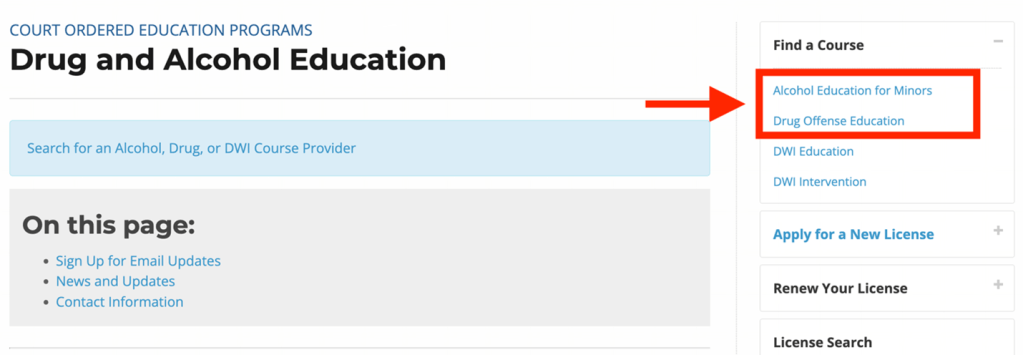
Section 106.115(a) provides that the Texas Department of Licensing and Regulation (TDLR) approves alcohol awareness programs. Even though Section 106.115(a) further provides that the Department of State Health Services approves the drug awareness program, 16 Texas Administrative Code Section 90.1 transfers this authority to TDLR. Therefore, starting June 1, TDLR will be responsible for approving any course available under Section 106.115(a). TDLR’s website provides searchable lists for approved alcohol awareness and drug awareness courses:

But can these courses be completed online? Section 171.0055 of the Government Code provides that TDLR-approved court-ordered programs—including those ordered under Section 106.115(a)—may be in-person or virtual. Section 171.0055 was created in 2021 by the same Legislature that repealed DADAP.

TMCEC randomly accessed a few of the course links on each list above and found that many courses offered have a virtual/online option, typically using Zoom. Thus, even though DADAP will no longer be an option on June 1, minor defendants convicted of or granted deferred disposition for alcohol offenses will continue to have online options to complete any required course ordered under Section 106.115(a).

Call of the Week: Minor in Possession of Tobacco

By Benjamin Gibbs

As public opinion on tobacco has shifted, so, too, has the law on underage possession. In the 88th legislature, there are bills introduced which would criminalize selling “alternative nicotine products” and certain flavors of tobacco to minors. See e.g., 88th legislature, SB 920, HB 4481. These bills would punish sellers, not underage possessors of these products. As currently written, they will not change the law regarding possession of tobacco offenses under Section 161.252, or the deferral under Section 161.253. In that interest, here is a quick refresher on the law as to underage possession of tobacco, e-cigarettes, and tobacco products.

Upon conviction of a tobacco offense by a minor, the court shall suspend execution of the sentence and order attendance at an e-cigarette and tobacco awareness program. Because this occurs after conviction, the court should also determine an appropriate fine, not to exceed $100.

From the first codification of this offense in 1997 until the revision in 2019, subsequent offenses under this section had a higher maximum fine. Although this is no longer the case, there is a provision which echoes that. For a first conviction under Section 161.252, if the defendant completes the ordered course (or community service if the course is unavailable), the court shall discharge the defendant and dismiss the complaint. If the defendant completes the course, and the court discharges the defendant under this provision, all penalties and disabilities are released, including the fine and court costs. The only impact that will remain is that this will be considered a prior conviction for purposes of Section 161.253.

If the defendant has been previously convicted of an offense under Section 161.252, even if the conviction was previously dismissed after completion of an awareness program, the penalty is modified. If the defendant does not complete the program, the fine assessed upon conviction, up to $100, remains. If the defendant does complete the program, the fine may be reduced, at the discretion of the court, to not less than half of the amount previously imposed. This is not a reassessment of the fine but should be based upon the amount of the fine assessed at the time of conviction.

There is also a special expunction provision under Subchapter N. On or after the individual’s 21st birthday, and for a fee of $30 per offense, the defendant may apply to have any number of convictions under Section 161.252 expunged. The expunction is mandatory if the defendant applies, and there is no requirement that the defendant have completed the required course under Section 161.253 before applying for expunction.

Remote Possibilities: Post-Emergency Zoom Hearings

On January 27, 2023, the Supreme Court of Texas issued the Final General Emergency Order Regarding the COVID-19 State of Disaster. The Final Order renewed and amended the Fifty-Ninth Emergency Order and granted special rules pursuant to Governor Abbott’s declared state of disaster. The Final Order was effective February 1, 2023, and expired March 1, 2023.

The Final Order continued the practice of the previous orders, and provided specific authority for courts to operate remotely. All courts in Texas in any criminal case were authorized to require participants involved in a hearing to participate remotely, such as by teleconferencing, videoconferencing, or other means.  After consideration on the record or in a written order, municipal courts were authorized to require a lawyer, party, or juror to appear remotely. Courts were also authorized to conduct proceedings away from the courts’ usual location, if certain criteria were met.

Now that the Order has expired, courts have the same ability to conduct remote proceedings that they had prior to the first order, issued on March 13, 2020. If that ability exists, a court must find it in statutory authority or, arguably, its own inherent power. But if a court could not conduct a proceeding remotely prior to March 13, 2020, how can it today?

There is no general authority for courts to conduct proceedings remotely. Court processes have, for decades, been organized around a presumption that a court is a physical location, and a court proceeding is a process that occurs in that location. Court jurisdiction is described by the court’s physical location. Several important rights have been shaped by the concept of a physical gathering place for court, such as the right to confront witnesses, the right to a public trial, the rules of hearsay, and the process of voir dire. While none of those rights absolutely requires physical presence, the history and case law surrounding them has been shaped by the idea of it. With that in mind, beyond constitutional limitations, there are few times in law when conducting remote or videoconference proceedings is expressly prohibited.

Before the Emergency Orders, there was certainly some express authority in the Code of Criminal Procedure for conducting remote or videoconference proceedings:

  • Article 15.17 expressly allows a magistrate to deliver required warnings and information by two-way electronic videoconference, with image and sound. This proceeding is required for any person arrested, whether they are subsequently brought to the jail or released for a later appearance before a magistrate under Article 14.06.
  • Article 27.18 allows acceptance of a plea by videoconference, with the written agreement of the defendant and the State, provided the videoconference allows simultaneous full motion video and interactive communication of image and sound and the defendant can communicate privately with the defendant’s attorney without being recorded or overheard.
  • Proceedings in municipal courts are governed by Chapter 45 of the Code of Criminal Procedure. In Chapter 45, there is some express authority to conduct remote and videoconference proceedings and possible implied authority:
    • Article 45.0201 expressly allows appearance by telephone or videoconference for hearings under Article 45.0445 (Reconsideration of Satisfaction of Fine or Costs) and Article 45.045 (Capias Pro Fine). Article 45.046 allows videoconferencing for commitment hearings.
    • Some practitioners find implied authority for videoconference or other remote proceedings in Articles 45.001 and 45.002. Under those articles, courts are directed to construe Chapter 45 to ensure appropriate dignity in court procedure without undue formalism, and to process cases without unnecessary expense or delay. Where the chapter does not provide a rule, courts are directed to apply other general provisions of the Code of Criminal Procedure “to the extent necessary to achieve the objectives” of the chapter. Although this obviously does not use the term “videoconference,” some practitioners read into this article a permissiveness for municipal courts.

Without the clear and specific authority previously offered to courts in the Emergency Orders, courts must continue under authority offered in the Code of Criminal Procedure. Some courts see many benefits to virtual proceedings but have halted the practice absent specific authority from the Legislature or caselaw. Others may find enough permissive authority in Chapter 45 or their inherent power to carry on with virtual proceedings. All courts, however, would benefit from clear guidance regarding virtual hearings coming out of the 88th Legislature. As of now, TMCEC has identified no bills filed that would expressly authorize virtual hearings for municipal courts. The filing deadline for legislation this session is March 10, 2023. Courts should always remember that any process employed must conform to due process and respect the rights of the accused at every step of the process.


TMCEC’s 2023 Prosecutor Seminar is Approaching!

A well-informed prosecutor that stays apprised of changes to the law and follows established best practices improves the efficiency of justice.

TMCEC is hosting the first of two AY23 Prosecutors Seminars February 22-24, 2023 at the Holiday Inn Riverwalk in San Antonio.

Since 1992, TMCEC has offered specialized continuing legal education to prosecuting attorneys who serve in municipal courts across the state. Currently, more than 700 attorneys licensed in Texas prosecute in municipal courts. The TMCEC Prosecutors Seminar is uniquely designed to help prosecutors and other attorneys stay abreast of information necessary to maintain professional competence.

The TMCEC Prosecutors Seminar is open to prosecutors of all experience levels. Topics include trial skills, legislative and case law updates, case management, and more! You may view the current agenda here. Attendees are eligible to receive up to 14 CLE hours (including 2 hours of ethics). See the tentative agenda below.

If you are a municipal judge or clerk, TMCEC encourages you to share the conference flyer with your court’s prosecutor(s) and/or city attorney(s)! Seminar registration fees are $250 (including CLE reporting) and $50/night for a private, single occupancy room at the Holiday Inn. Register today at register.tmcec.com! Questions? Contact TMCEC at info@tmcec.com or 512-320-8274.

From general information about TMCEC’s Prosecutors program, visit www.tmcec.com/programs/prosecutors/.

The Supreme Court Issues 59th COVID-19 Emergency Order

On December 30, 2022, The Supreme Court Issued the 59th COVID-19 Emergency Order. The order goes into effect on January 1, 2023 and expires February 1, 2023. Of note, all courts in Texas may allow or require a participant to participate remotely, such as by teleconferencing, videoconferencing, or other means.

Municipal courts may not require a participant (lawyer, party, or juror) to appear remotely for a jury trial unless the court has considered on the record or in a written order any objection or motion related to proceeding with the jury trial at least seven days before the jury trial, or as soon as practicable if the objection or motion is filed within seven days of the proceeding.

The full order is available below.

Financial Responsibility Through Auto Insurance

Whether it be for the purposes of a Failure to Maintain Financial Responsibility (FMFR) charge or to determine eligibility for a driving safety course (DSC), municipal courts in Texas are frequently presented with paperwork that a defendant believes shows their financial responsibility through motor vehicle liability insurance. At the TMCEC Central Texas Regional Judges and Clerks Seminar in Austin last month, multiple discussions broke out about best practices for municipal courts to validate whether such paperwork indeed shows that the defendant was or is covered. Courts generally need to assess the provided evidence of motor vehicle liability insurance on a case-by-case basis as the policies defendants present to courts vary greatly. Thankfully, there is statutory authority to guide these assessments.

Subchapter D of Chapter 601 of the Transportation Code (“Establishment of Financial Responsibility Through Motor Vehicle Liability Insurance”) lays out the requirements. The policy must be either an owner’s policy or an operator’s policy. An owner’s policy is tied to a specific vehicle and covers the vehicle’s owner and anyone operating that vehicle with the owner’s permission. An operator’s policy is tied to an individual and covers the policyholder in any vehicle they operate. Operator’s policies are usually held by individuals that do not own a vehicle. There is no requirement in Subchapter D that the policy be “in the defendant’s name.” Owner’s policies cover people whose names are not listed on the policy. Courts should confirm, however, that a defendant is not expressly excluded from coverage in the specific policy.

TMCEC recognizes the difficulty municipal courts face when a defendant provides an owner’s policy that covers a vehicle that the defendant does not own. In these cases, follow-up questions may be warranted, such as whether the covered vehicle is owned by a family member of the defendant or whether the policy covers the vehicle that the defendant most regularly uses. Section 601.076 of the Transportation Code includes within the required terms on an owner’s policy that it cover a vehicle and pay on behalf of the named insured or another person who uses the vehicle with express or implied permission. Additionally, Section 601.054 states that evidence from an owner shall be accepted for a driver that is an employee of the owner or that is a member of the owner’s immediate family or household.

Recent legislation might also help. H.B. 1693 (2021) gave municipal courts authorization to access TexasSure, which is the program law enforcement typically uses to determine a motorist’s insurance status during a traffic stop. TexasSure is limited, however, in that it cannot provide a person’s insurance status on a previous date. Thus, TexasSure might prove most helpful for the purposes of DSC where courts need only ascertain the defendant’s insurance status at the time of the request. Its utility may be limited in the context of FMFR charges where the question is whether the defendant was insured at the time they were cited.