by Mark Goodner and Ned Minevitz
Understanding the Expanded Mandatory Credit in Fine-Only Cases
A recent amendment to Article 45A.251, Code of Criminal Procedure, has expanded when mandatory jail credit applies in fine-only misdemeanor cases. Because municipal courts already apply multiple forms of jail credit, it is important to clearly separate what changed from what did not.
This post focuses exclusively on subsection (e) of Article 45A.251.
What This Is Not About
H.B. 16 makes no changes to jail credit under Article 45A.251(d). That provision applies when a defendant is confined on the court’s charge prior to judgment. Judges are already familiar with this type of jail credit, and it continues to operate exactly as it did before the 2025 amendment.
What This Is About
Subsection (e) modifies a separate and additional category of mandatory jail credit in fine-only misdemeanor cases—one that applies even when the confinement had nothing to do with the case that the credit is being applied to.
The Rule (Simplified)
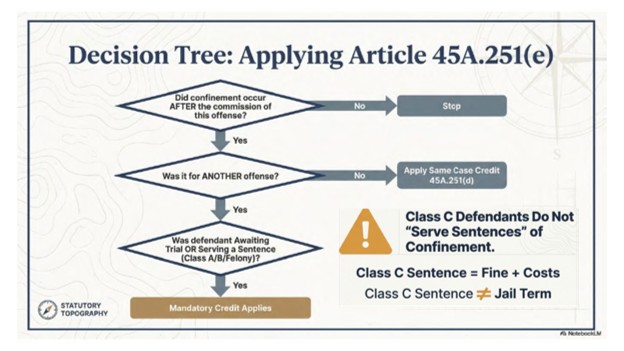
When imposing a fine and costs in a fine-only case, the judge shall credit the defendant, at a rate of not less than $150 per day, for any period the defendant was confined:
- while awaiting trial or serving a sentence for another offense; and
- the confinement occurred after the commission of the offense the credit is being applied to.
Once these requirements are met, the credit is mandatory.
Why the 2025 Amendment Matters
The Pre-2025 Framework
When subsection (e) was first enacted in 2021, it applied only to confinement “while serving a sentence for another offense.” That limitation had an important consequence in fine-only cases.
No defendant ever serves a jail sentence for a fine only misdemeanor. As stated in Art. 4.14(c), C.C.P., an offense which is punishable by “fine only” is defined as an offense that is punishable by fine and such sanctions, if any, as authorized by statute not consisting of confinement in jail or imprisonment. Art. 45A.251(a) further clarifies “The judgment and sentence for a conviction in a criminal action before a justice or judge is that the defendant pay the amount of the fine and costs to the state.”
As a result, time spent in jail related to a Class C offense—whether following arrest or after a capias pro fine and commitment—did not qualify for mandatory jail credit under subsection (e). That confinement was not time spent “serving a sentence.” Therefore, before 2025, subsection (e) only applied to Class B misdemeanor or higher offenses.
What the 2025 Amendment Expanded
In 2025, the Legislature added the phrase “awaiting trial” to subsection (e). This change expands the statute to require mandatory credit for pre-judgment confinement connected to another offense, even when no sentence has been imposed.
Important clarification:
Under subsection (e), both “awaiting trial” and “serving a sentence” always refer to another offense, not the case the credit it is being applied to.
What Does “Awaiting Trial” Mean?
By adding “awaiting trial,” the Legislature recognized that defendants may spend time in jail or prison before judgment “for another offense” and that confinement may now trigger mandatory credit in a fine-only case. While “another offense” is not defined, we can turn to the statute for some clues about what this means. Article 45A.251 is the Judgment statute, instructing judges about the specific procedure and requirements in entering judgment for the class C case before them. In subchapter (e), “another offense” indicates that the analysis regarding mandatory credit is for time spent on a different case than the one for which judgment is being entered. This could be another offense pending or adjudicated in another court (like a county or district court, for example) or even another case in the same court.
The statute does not define “awaiting trial,” and there is currently no case law interpreting the phrase in the context of Art. 45A.251(e). The most prudent approach may be to consider any time spent in jail before judgment as time spent “awaiting trial” regardless of whether a trial ultimately took place.
Following this approach, the other offense could be a Class C charge, such as public intoxication, if the defendant was confined following arrest.
What the Amendment Did Not Change
Although the 2025 amendment expanded eligibility, it did not eliminate important limits.
- A Class C offense can never generate qualifying confinement through “serving a sentence.” In municipal and justice courts, the sentence must only be to pay a fine and costs to the state. Municipal courts and justice courts may not impose jail sentences for fine-only offenses. Defendants heading to jail post-conviction in municipal or justice courts are heading there not as part of a sentence but after a commitment as a result of the defendant’s failure to comply with the terms of the judgment.
- Time spent in jail after a Chapter 45A capias pro fine and commitment does not qualify as “awaiting trial” under subsection (e) either. That confinement is post-judgment, and therefore the convicted defendant is not “awaiting trial.”
- Subsection (e) does not convert fine-only enforcement mechanisms, via commitment to jail, into jail sentences and does not authorize fines to be “laid out” through confinement.
Timing Matters: Why This Credit Appears in the Judgment Statute
Subsection (e) appears in Article 45A.251, the Judgment statute. That placement is significant.
It gives courts clear chronological bookends:
- the date the fine-only offense to which credit it being applied was committed; and
- the moment judgment is imposed.
Only confinement that occurred after the offense was committed and before judgment is entered can trigger mandatory credit under subsection (e). This structure keeps the analysis grounded at the time of judgment and prevents retroactive application.
Practical Considerations for Courts
Subsection (e) credit is applied at the time of judgment, and courts can only apply it when they have information showing it applies.
In practice:
- The issue is most often raised by the defendant, either orally at judgment or through a written request. Courts do have a duty to credit qualifying time served, however, and should inform defendants of the requirement.
- If the defendant is present, the court may ask whether the defendant has spent time confined awaiting trial or serving a sentence for another offense since the date of the offense to which credit might be applied. The statute does not address what type of documentation is required from the defendant.
- If the defendant is not present, the court may review the file to determine whether a request or documentation has been submitted.
Bottom Line
H.B. 16 expanded mandatory jail credit in fine-only cases, but it did so carefully, not categorically.
- Time spent in jail before judgment in any category of criminal case may now trigger mandatory jail credit against Class C misdemeanor judgments.
- Post-judgment confinement for a Class C misdemeanor remains outside subsection (e).
Handled correctly, subsection (e) provides meaningful indigency relief without undermining the structure of fine-only sentencing in municipal courts.
To learn more on this topic, there was a webinar on February 12, 2026 (offering judicial education, clerk certification credit, and CLE) titled Jail Credit in Municipal Courts: Surveying the 2026 Landscape. That webinar is now available on-demand.
 Full Court Press